Tuesday, February 10, 2026
The science of learning Kanji
There are a couple of established approaches for learning Kanji
- The school method Drills & repetition
- The breakdown method Learning small kanji components ("radicals") instead of the full kanji
- The keyword method Establishing keywords or mnemonics for each kanji
Most ressources like JPDB, Wanikani or Heisig's "remembering the kanj" use a mix of the last two methods. Language schools, especially in Asia generally use the first. On forums you can also find language learners that recommend completely skipping all that complexity and just straight up learning entire words with their kanji.
Breaking down Kanji works
This 1999 study compared different strategies for teaching chinese characters and found that the group using radicals had the best results both in the short term and the long term.
This is most likely due to chunking. If you try to learn a character like 亰 by itself then you'll have to memorize each of the 9 strokes that its made up of. Each stroke is one thing to remember.
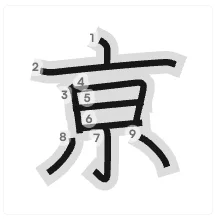
But if we already know 亠日 and 小 then our brain just has to remember 3 things instead of 9!
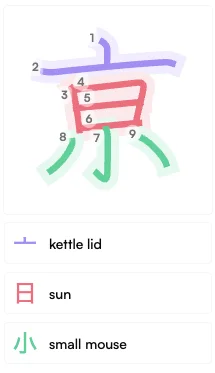
As you become more and more advanced, your brain will adapt more and more to learn kanji and you'll be able to encode them more and more efficiently.
Keywords & the concreteness effect
You've probably used mnemonics before or heard about them. They work really well in the short term but they can be a lot of effort to build up and maintain.
If you've learned a language before you probably noticed that you just learn some words instantly while others never seem to stick. Here are some words, you can click on them to reveal them.
These are all fairly common words that you've probably heard before. The biggest difference between them is how concrete they are. Some will be connected to a single clear image or idea in your mind, while others can take on many meanings and don't fit neatly into a clear word category.
If you try to recall them now there's a good chance some will pop to mind instantly while others will be harder or even impossible to remember. I'd expect you to remember them in this order: beanbag, director, function, enough
This is called the Concreteness Effect and we can abuse it by making sure that all the keywords we chose adhere to it! Words like "mistake", "resemble", "trust" make for much weaker keywords than "idiot", "twin", "traitor" while still attaching the same kind of meaning.
This effect is very pronounced, some studies see 2x better retention for concrete words than abstract ones. I made a full breakdown of the science here.
Summary
The breakdown and keyword methods will take most of the frustration out of learning Kanji. All that's left to do is to use an SRS like Anki, Langkit or JPDB to quiz yourself on their meanings. You only really need 1000 to be able to understand the rough meaning of most texts which, using the strategies outlined above, is very achievable in a year or so!